Speaking to Patient Empowerment
A few years ago, I had the honor of speaking on the patient panel at the Coastal Research Institute Empower You conference. This was a landmark event that truly delivered in all areas...in the information presented, how it was conveyed, by whom, and what patients got out of it.
The message, more than any treatment option or tech/device related education, was that WE as patients are responsible for more of our care than we realize, and that doctors ability to use these interventions is frankly limited and not always equally appropriate/risky.
A 'good' or 'bad' treatment decision depends on the patient. We are the ones who have to navigate and understand those variables, what our goals and realities are, and what else can we impact besides what these pain interventionist can address with their skills.
I could not have been more grateful for the kindness and inclusivity of everyone involved, along with the genuine interest the physicians and panelists showed in the information I had to share about our challenges with care, medication side effects, DRG stimulation, experiences in PT etc. and brought the same passion for their own topic sessions.
What was truly reinforced was partnership, teamwork, and collaboration - in actions as well as words.
We all put our shoes on the same way...Like with sports, it's easy for patients to forget Doctors are just people too. Though they are incredibly smart and gifted and often play the role of God in our lives, interventional pain doctors have a hard job too. And it's just one piece of the treatment puzzle with chronic pain - albeit probably the most important one to navigate correctly.
Yet understanding the landscape of treatment options and algorithms doctors use to recommend treatments is typically a process patients are not privy too - which always felt odd to me when we're the ones living with the decision.
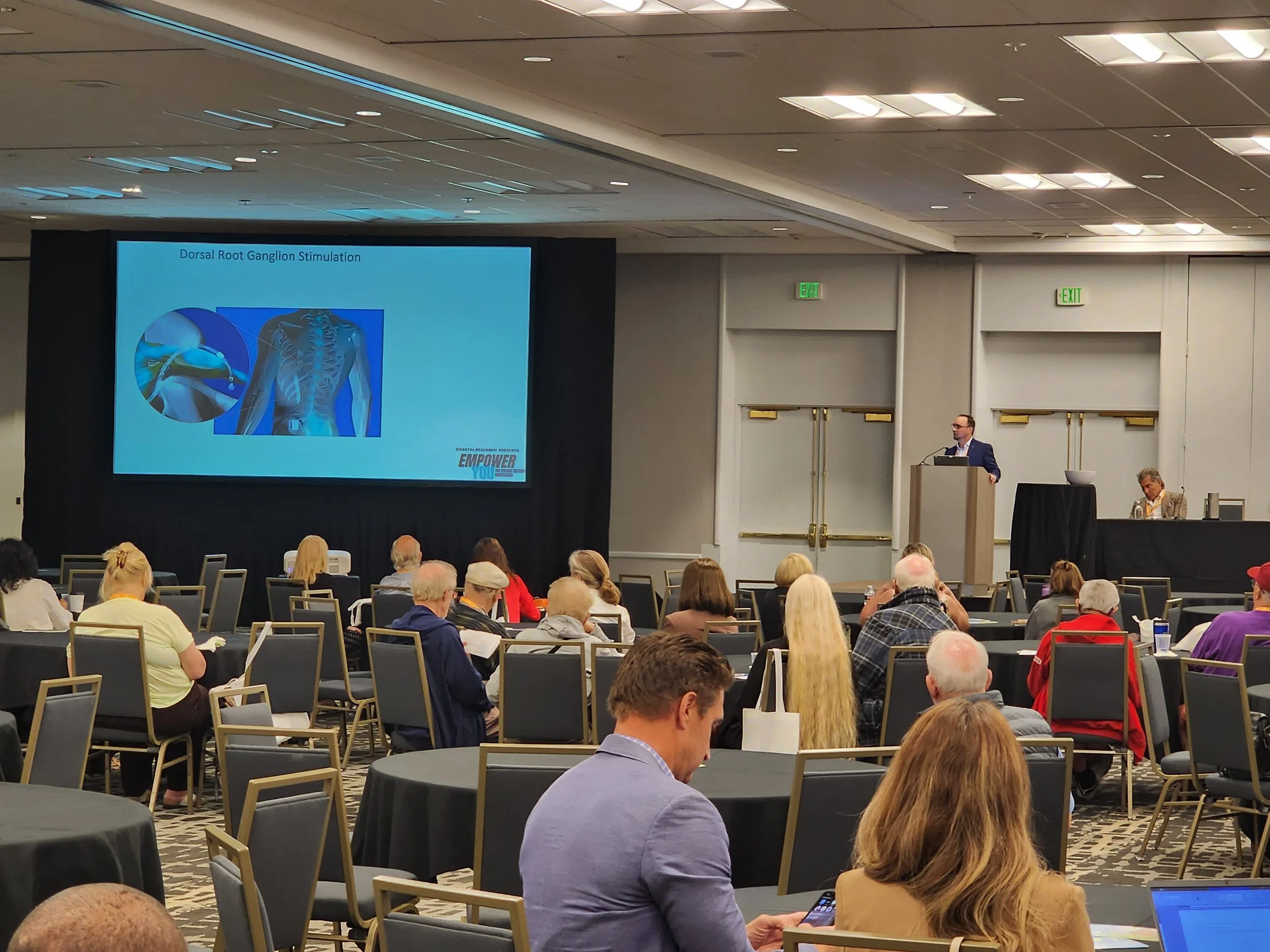
Neuromodulation (dorsal root ganglion and spinal cord stimulation) presentation at a patient centric conference.
Illnesses, pain and people are complex. What's right for you is not right for someone else in the seemingly same situation. You have to be able to ask the right questions and think critically. And the patients who attended this conference are now much better equipped, as opposed to relying on whatever their one pain doctor may suggest or know based upon their specialty and interests. That is not offensive, it's just the truth; and patients need to feel they have permission and are enouraged to bring solutions, ideas and information to the table.
That is empowerment. That is what creates more personalized care and better outcomes.
Everyones knowledge and experience is limited. And we as patients get the best results when we know that about Doctors and don't expect them to do or come up with everything. They can't. We need to actively participate in that process as well. We have to educate ourselves and then bring that to the table.
In my work with complex patients, I see time and time again how the system has failed us. That's unfortunately the point at which patients usually end up in my hands...After years of medical trauma and poor relationships with providers, thinking they had no other options.
There is then so much damage to undo and opportunities lost that cannot necessarily be recovered. Though the bulk of the responsibility for our healing lies on our shoulders, fair or not, the truth is we NEED medical professionals when dealing with one of the most challenging, insidious, progressive diseases that exist.
We cannot do this alone. We need better awareness, education, and access. And it's one thing for me to foster this with every individual who crosses my path. It's another when the folks holding the needles/scalpels are on the same mission.
For the first two years, I built Resilient Warrior Coaching and helped patients empower themselves to navigate the complex world of chronic pain with CRPS completely by myself. The last two, I have partnered with more of the medical community to bring pain education to both patients and clinicians in a way that is severely lacking in the chronic pain space. You can check out my speech on the panel here, and my ongoing work with Dr. Dan Bates on It’s Not in Your Head podcast for more education on treating neuropathic pain, sensitization and so much more that comes along with complex pain pathologies.